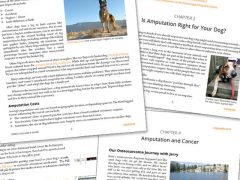
When you want all of your canine amputation recovery and health questions answered fast, this Tripawds Library Bonus Package gives you a complete education about life on three legs. Purchase your download below to start studying in minutes or read on for complete details about what’s included in this special offer.
Save time and money with all the critical information you need to help your dog right at your fingertips. This complete resource includes both of the first two Tripawds e-books, packed with information and helpful tips about amputation recovery, ongoing care canine rehab and exercise to help you keep your dog healthy and strong. More Info »
Price: $29.00$24.95
Tripawds E-books: Buy Two and Save!
Whether your dog is facing limb amputation because of illness or accident, you are thinking about adopting a fully-grown canine amputee, or you just want to keep your current three legged dog healthy and strong, this Tripawds Library Bonus Package is for you! Featuring both Three Legs & a Spare and Loving Life on Three Legs, this indispensable resource is packed with more than 225 pages of helpful information for your amputee dog education.
SAVE $8.95 and get FREE BONUS MATERIAL
when you buy both books at the same time!
Tripawds 101: Three Legs and a Spare
When coping with an amputation for your dog, you need answers, and you need them fast. Three Legs & a Spare will help you prepare for your best friend’s new life on three legs.
Three Legs & a Spare: A Canine Amputation Handbook features the best tips and advice from more than six years of compiling Tripawds community resources about canine amputees.
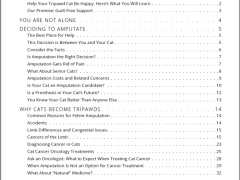
This 110-page interactive PDF contains the best advice from more than 5,500 Tripawds community members. With hundreds of informative links, Three Legs & a Spare will save you time and provide immediate answers to your questions.
Quickly find information about common concerns such as:
Canine amputation surgery costs
How to decide if amputation is right for your dog
Preparing yourself, your dog and your home
Pre-amputation questions to ask your vet
Post-surgery pain management strategies
Common amputation recovery concerns, and how to handle them
This second phase of your Tripawds education is all about maintaining good health and fitness for canine amputees. Help your dog live a long happy life with information from veterinarians and certified vet rehab therapists, along with hundreds of direct links to articles, forum topics, interviews and how-to videos for exercises you can do at home.
In this 115-page interactive PDF we share critical information that every Tripawd parent should know, including helpful tips about things like:
Preparing for your “new normal”
Surgery recovery and pain management
Why strong core muscles prevent injuries
Canine rehabilitation therapy basics
Finding a qualified rehab therapy program
Do-it-yourself stretching, massage, and exercises.
Diet, supplement and nutrition basics
Keeping the golden years golden
Case studies of dogs loving life on three legs
And much more!
Class is in Session
Are you ready to get your Tripawds diploma? Download both books today and you also get:
Tripawd Caregiver/Petsitter Instructions
New Tripawd Daily Treatment Regimen
Important Veterinary Questions
Exercise Routine Worksheet
Dog Diet Plan & Nutrition Worksheet
Purina Body Conditioning Chart Printout
Plans for building your own homemade Buja Board
Each e-book includes hundreds of direct links to the most informative Tripawds blog posts, forum topics, interviews and how-to videos. This Tripawds Library bonus offer combines both books in one document you can read offline!
Save time and money with all the critical information you need to help your dog right at your fingertips. This complete resource includes both of the first two Tripawds e-books, packed with information and helpful tips about amputation recovery, ongoing care canine rehab and exercise to help you keep your dog healthy and strong. More Info »
The Tripawds canine amputation recovery and care e-book includes fast answers to the most common questions about amputation recovery and caring for a three legged dog. Now in its second edition, this 110 page interactive PDF includes hundreds of direct links to the best blog posts, forum topics, videos and more helpful resources. More Info »
The Tripawds canine fitness and conditioning handbook is a vital resource for keeping any dog healthy and strong! This 115 page interactive PDF includes the professional advice of veterinarians and certified vet rehab therapists, along with hundreds of direct links to articles, forum topics, interviews and how-to videos for exercises you can do at home with your three or four legged pup. More Info »
Do you know how to keep your three-legged dog injury-free?
Download the new Tripawds e-book, Loving Life on Three Legs: Canine Fitness and Conditioning for Happy, Healthy Tripawds for all the tools you need to help your three-legged hero get fit and stay strong for an injury-free life.
While this book is written for Tripawd parents, the information is ideal for helping any dog stay in top shape for life!
Purchase your download using the button below and start reading in minutes, or read on for complete details.
The Tripawds canine fitness and conditioning handbook is a vital resource for keeping any dog healthy and strong! This 115 page interactive PDF includes the professional advice of veterinarians and certified vet rehab therapists, along with hundreds of direct links to articles, forum topics, interviews and how-to videos for exercises you can do at home with your three or four legged pup. More Info »
Price: $19.95$16.95
Keep Your Three-Legged Dog Safe, Fit and Healthy
Nearly six years in the making, this second e-book in the Tripawds Series is all about maintaining good health and fitness for canine amputees. Help your dog live a long happy life with information from veterinarians and certified vet rehab therapists, along with hundreds of direct links to articles, forum topics, interviews and how-to videos for exercises you can do at home.
In this 115-page interactive PDF we share critical information that every Tripawd parent should know, including helpful tips about things like:
Preparing for your “new normal”
Surgery recovery and pain management
Why strong core muscles prevent injuries
Canine rehabilitation therapy basics
Finding a qualified rehab therapy program
Do-it-yourself stretching, massage, and exercises.
Diet, supplement and nutrition basics
Keeping the golden years golden
Case studies of dogs loving life on three legs
And much more!
Packed with hundreds of direct links to the most helpful discussions with veterinary professionals and Tripawds community members, Loving Life on Three Legs is the world’s first canine rehabilitation e-book created specifically for canine amputees.
The Best Tripawd Fitness Tips
Since the earliest days of the Tripawds community back in 2006, it has been our mission to present accurate and helpful information about keeping Tripawd dogs safe and strong after amputation surgery.
We are now bringing all the best resources for rehabilitation and exercise to you in one indispensable e-book which can help you and your pup quickly hop on the road to recovery and achieve an injury-free future.
Although this book is tailor-made for the Tripawds community, parents of four-legged canines will find much of the information inside just as valuable for helping their own four-lagged dogs. With one click you and your entire pack can achieve peak fitness and have fun doing it!
With apologies to the feline members of Tripawds, we regret there just isn’t enough research about feline Tripawd fitness and rehabilitation therapy to make this a cross-species edition. We expect future years will provide adequate cat amputee fitness tips for revised editions.
Lessons Learned: Why We Created This Book
When Tripawds founder Spirit Jerry G. Dawg lost his leg to osteosarcoma in 2006, we didn’t know anything about keeping him injury-free after surgery, and at the time it seemed like his surgeon didn’t know either.
Statistically he wasn’t expected to live more than a few months, but just over one year past his diagnosis he was still defying expectations.
Jerry was strong and happy and we continued to play the games we all loved most. The extent of our injury prevention measures boiled down to shorter walks and modified Frisbee sessions to ensure Jerry wouldn’t jump too high on that one remaining front leg.
We thought we were playing it safe. Until one day, Jerry suddenly sat down during our Frisbee hour and couldn’t get up. Our poor Tripawd was hurt, and it was all our fault.
That moment marked the beginning of our extensive research about how to prevent injuries for three-legged dogs. Now, six years and 5,500 Tripawds members later, we bring the knowledge we’ve acquired from the professional veterinary community and members just like you in this canine rehab handbook, Loving Life on Three Legs.
Start Loving Life on Three Legs Today!
This e-book shares professional feedback about Tripawds from veterinarians and certified vet rehab therapists, along with hundreds of direct links to articles, forum topics, interviews and how-to videos for exercises you can do at home with your three or four legged pup.
And, it is a constantly evolving resource. As new information about canine rehabilitation therapy becomes available, we will periodically update this book. Once you purchase it, you will be able to download the PDF up to ten times, any time in the future.
Whether your dog is young or old, with three legs or four, the information in this canine rehabilitation and fitness handbook can help you help him live a long healthy life! Download this e-book now to understand the importance of core strengthening, discover how to massage and stretch your dog to prevent injuries, and learn how to build your own obstacle course to improve your dogs mobility.
New to The Tripawds Journey?
Loving Life on Three Legs was written specifically to help Tripawd parents who have already been through the first few weeks of the amputation recovery process. This book builds on the information we present in our first e-book, Three Legs & a Spare, a Canine Amputation Handbook. If your dog has been newly diagnosed with a condition requiring amputation surgery, you will benefit the most by purchasing our first e-book and reading it prior to this one.
Satisfaction Guaranteed!
We know you’ll find this book helpful but if for some reason you are not completely satisfied, just let us know within fourteen days of your purchase for a full refund. All proceeds from e-book sales help to cover the high costs of maintaining the free Tripawds community. We are grateful for your support.
Download Loving Life on Three Legs today, then read it whenever you can. You don’t have to be online to do so, but its greatest value is in the many links for viewing videos or more information on the web.
iPAD USERS: Please save the PDF to your hard drive. Viewing on an iPad will load the file in your browser by default and there is a limit of 10 downloads!
The Tripawds canine fitness and conditioning handbook is a vital resource for keeping any dog healthy and strong! This 115 page interactive PDF includes the professional advice of veterinarians and certified vet rehab therapists, along with hundreds of direct links to articles, forum topics, interviews and how-to videos for exercises you can do at home with your three or four legged pup. More Info »
Price: $19.95$16.95
Or, save time and money with both of the first two Tripawds e-books at one low price!
Save time and money with all the critical information you need to help your dog right at your fingertips. This complete resource includes both of the first two Tripawds e-books, packed with information and helpful tips about amputation recovery, ongoing care canine rehab and exercise to help you keep your dog healthy and strong. More Info »
Price: $29.00$24.95
Thank You Tripawds Friends and Families
This book is made possible thanks to the thousands of members who have contributed to the discussions at Tripawds.com. With each new story and experience shared in our community, we can make this journey just a little easier for new Tripawds parents.
Got ideas for the book? Your feedback is appreciated. Contact us and let us know how we can make it better. Please provide your order ID when inquiring about your purchase or check your order status here.
Hoppy Reading!
Disclaimer: Please remember, we (the authors, Jim and Rene) are not veterinarians. Much of the information presented in our e-books and throughout the Tripawds.com community is based on our own experiences caring for Jerry and Wyatt and the experiences of other Tripawds members as well as those of the veterinary and animal health community. This information is not a substitute for medical care by a qualified veterinary professional. Always seek the advice of a licensed veterinarian prior to making any medical decisions or undergoing treatments or therapies, or if you have questions about your Tripawd’s health. Never delay treatment or disregard professional medical advice based on something you read in this e-book or on Tripawds.com
Tripawds parties happen all across North America, but they only happen when one pawrent takes the first step to organize one. If you’d like to gather three legged Tripawds in your community you’ll find plenty of ways to outreach to others and create an official Tripawds chapter where you live, including this free Tripawds Pawty Flyer Word Document Template.
Download a Flyer Template
Our friends at Tripawds of Alberta are having regular gatherings. Alberta Tripawds member Teena Hopper of Tails a Waggin’ recently created this lovely logo for their Tripawds chapter!*
Teena has generously updated our Tripawds Pawty flyer template, which you can download here:
This fun flyer was originally created by gerrysmom when she wanted to organize a three legged meet-up in her hometown of Madison, Wisconsin.
Once you download your flyer, save it to your hard drive and add your information. Then you can:
Post fliers at local feed stores and dog-friendly watering holes
Create a Craig’s List posting
Write a press release and call local TV and newspaper reporters
Finally, be sure to announce your three legged gathering with a new topic in the Tripawd Parties discussion forum as well as on our Facebook page. You never know who your nearest Tripawd neighbor will be!
Create Your Own Tripawds flyers
Do you want your Tripawd to be the star of your own flyer about three-legged dogs? If so, create your own Tripawds flyer.
*Please note: Because the word “Tripawds” and “It’s better to hop on three than limp on four” are registered trademarks, we want to ensure a consistent use of them, so please email your flyer design to us before distributing.
You may utilize these high-resolution logos in your poster, press release and other announcements:
We encourage you to have fun doing outreach in your city. If you are interested in attending an event as a Tripawds representative, please contact us today so that we can exchange ideas about how you can help get the word out to as many folks as pawsible at each event!
This 30 minute Internet TV show features Tango, Vader and Caroline as well as representatives from Yellowdog, an organization dedicated to creating awareness about giving sensitive dogs breathing room in public spaces.
Three paws up to Caroline, Tango and Vader for tirelessly working to get the word out about the amazing capabilities of three legged dogs and cats.
For information about how to start
a Tripawds International Chapter, please contact us today.
When Tripawds founder Spirit Jerry lost his leg, we didn’t know what we could be doing to make him more comfortable and live a safer, injury-free life. Today thanks to increasing numbers of canine rehabilitation therapists, more Tripawds are living healthier lives, free of aches and pains.
The following downloadable PDF from Today’s Veterinary Practice Journal is written by one of the world’s leading canine rehabilitation therapists, Dr. Debbie Gross Saunders, DPT, MSPT, CCRP Diplomate ABPTS.
Titled “Early Rehabilitation: Modalities and Exercises,” this article is written for veterinarians but it will give you an understanding about the types of treatments that are available for canine rehabilitation protocols.
Dr. Saunders writes:
A multimodal approach should be taken with every rehabilitation patient and consists of:
Decreasing pain
Increasing range of motion
Increasing strength
Restoring tissue function.
In addition, inflammation will need to be decreased in order for function to be restored. Early rehabilitation modalities for patients that are post traumatic/athletic injury or surgery include:
Cryotherapy
Moist heat
Laser therapy
Range-of-motion and weight-shifting exercises
Controlled walking
Electrical stimulation
Massage therapy
We like this article because it outlines all of the canine rehabilitation therapy options that are available to parents. If you’re searching for a canine rehabilitation therapist, your best bet is to find a practice that employes multiple modalities for treating dogs. For example, swim therapy is great fun but should only be one small part of a canine rehab program. Look for practitioners who use multiple methods to help your Tripawd live a strong, healthy life.
If your dog or cat has just been diagnosed with the aggressive bone cancer known as osteosarcoma, grab a chair and watch this 1 hour and 50 minute video created by Nashville Veterinary SpecialistsDr. Jarrod M. Vancil, DVM, Diplomate ACVIM (Oncology) and Trey Calfee, DVM, MS, DACVS.
This presentation tells you how osteosarcoma is diagnosed and describes surgical options that are available to treat it (including limb sparing surgery). Drs. Vancil and Calfee discuss how they biopsy tissue samples and amputation surgery techniques they recommend for front and rear limbs.
In addition, the video covers a detailed discussion about different types of chemotherapy treatment plans as well as a comprehensive look at metastasis to other parts of the body.
While the video is clinical in nature, it is intended to give the layperson a solid understanding of what it means to be faced with this diagnosis. After watching the video you’ll have a clear enough understanding to have a lengthy Q&A session with your vet about your own dog or cat’s osteosarcoma diagnosis. We highly recommend setting aside some time to watch it.
A Tripawd pawrent’s biggest fear is for something to happen to their dog or cat’s remaining three limbs. While many Tripawds members have gone through major leg surgery after amputation, such as TPLO and FHO surgeries, members say the recovery process is even more challenging than amputation recovery.
If your vet is recommending a major ligament, knee or leg surgery on your Tripawd, take the time to get a second opinion, preferably from a veterinarian who is certified as a canine rehabilitation therapist.
A rehab vet might recommend a nonsurgical alternative called “conservative management” which has helped thousands of dogs recover from ligament injuries without surgery. While this approach takes dedication to following your rehab vet’s orders, and it might not necessarily cost less than a surgery, conservative management can help make life a lot easier for both you and your dog.
The following 2010 Whole Dog Journal article called “Alternatives to Canine Surgeries” highlights the basic facts about taking a non-surgical approach to your dog’s knee, leg or tendon injury. Download it below with this link, which will take you to a page where you can download the PDF.
To get a second opinion see a certified rehab vet (a trained vet with “CCRT” or “CCRP” after their names) before agreeing to any surgery procedure. Since animal physical rehabilitation is a relatively new field, your vet may not be able to provide you with a local referral. If that’s the case, visit these websites to find your closest rehab vet:
Have you and your Tripawd coped with a major surgery after amputation? If so comment below and share your experience with us.
Please be aware that we are not veterinarians. The information presented here is not meant to be construed as medical advice or guidance, nor should it be substituted for professional veterinary assistance. Always discuss any remedies and treatments you wish to pursue with your veterinarian. Tripawds is a user-supported community; all purchases made here help us continue providing resources and support to our Tripawd families. Thanks for shopping at Tripawds!
Did you know that until the mid 1980s, most veterinarians were taught that animals didn’t feel pain the same way that humans do? They were also taught that pain medication would hinder recovery, because the animal would theoretically harm itself when it felt better and move around too much. What a relief that these theories have been debunked and now we know that animals feel pain like humans do, and need appropriate pain relief to heal faster.
When an animal is in pain, their body language, facial expressions and behavior is noticeably different.
Whining, trembling and sudden guarding behavior are all indicators that something is wrong. It’s important to investigate any changes like this early on; if acute pain isn’t treated right away, the chances of it turning into a bigger, ongoing chronic issue are far greater.
How to Recognize Pain in your Dog or Cat
The following PDF download is an article from March 2012 that was published in the peer-reviewed journal, Today’s Veterinary Practice.
This article written by Anusha Balakrishnan, BVSc, and Elana Benasutti, CVT explains in detail how pain is assessed, what it looks like and provides suggestions to vets for managing pain. It’s a clinical article but one that the layperson can understand. We hope you find it useful:
Getting through some of the hardest times in life is easier if you stay focused on the moment right in front of you. While your head might be spinning with all of the treatment options, the “should haves” and “what ifs,” pause to take a careful look at your dog or cat.
Your pet isn’t sitting there feeling sorry for herself. While she might feel poorly because of disease, she’s not mad at you, or longing for the way things were. All she wants is for you to breathe, to smile, to be happy and do something fun together, right here at this very moment. Whether that’s stopping for a long cuddle session or throwing a ball, all that matters is the moment in front of you, because that’s is the only thing that we know we have for sure in this life.
The past is history, the future may never come, but today is a gift, that’s why it’s called the Present.
In this 40 minute keynote address filled with tips about dealing with cancer, we share the lessons that Tripawds founder Spirit Jerry taught us when we fought cancer together, and we highlight a handful of beautiful stories about Tripawds heroes. We hope you enjoy it.
No animal should suffer or be euthanized because their human can’t afford to pay for veterinary care.
If you are in the heartbreaking situation of having to forgo vet care for your companion animal, rest assured that many resources exist that can possibly help with the costs.
We have just updated the Tripawds Financial Resources PDF document with new funding sources around the U.S. A few exist in Canada and a listing for our UK members is also available. If you know of any that aren’t on this list, please let us know so we can add them.
As you know, many people are also experiencing hard times. Please don’t pin all of your hopes on these funding sources because most are overwhelmed with requests.
While you are waiting for an answer, take charge of your situation and raise as much money as you can by:
Hold a yard sale. For maximum impact, ask friends and family if they will add their unwanted stuff to the sale!
Create a flyer explaining your situation. Ask local pet businesses if you can post it in their location.
Be an entrepreneur! If you have kids, set up a good old-fashioned lemonade stand or some other kind of treat-stop. Have flyers ready to tell people why you are trying to make money.
Organize an event, like a walk-a-thon or some other kind of fun activity that will bring pet people together for your cause.
Sell items on eBay. You didn’t need that collection of bobbleheads anyways, right?
Use your social networking skills to spread the word about your pet’s situation. Although Tripawds doesn’t allow direct fundraising, we encourage people to use social networking to get the word out to friends and family.
Can you think of other ideas? Share them with us!
Finally, remember to be honest with your vet about what you can and can’t afford. Ask your vet to present all options available. Then ask if they will allow you to make payments. Many vets are willing to work with their clients to help provide affordable services, but you have to ask to know if yours will.
We hope you never need to refer to this document, but if you do, know that great charities exist to help people in these situations. And when you are in a good financial situation, we hope you’ll pay it forward by helping these organizations continue to do their work and donating to them. Thanks!